“We’d rather buy it, so it goes down as CAPEX.” We hear this often, most recently a few weeks ago, and the people who say it usually have good reasons. The asset belongs to the company, it sits on the balance sheet, the cost is spread over the years. For a warehouse or a production line, the reasoning holds.
For technology it holds less well, and not because of accounting formulas. It holds less well because it rests on an assumption that computers have stopped honouring: that the asset keeps its value for the whole period over which it is being depreciated.
CAPEX and OPEX: what the difference is, in plain terms
Two acronyms that have made their way into the meeting rooms of small companies too. CAPEX is capital expenditure: you buy an asset, record it among fixed assets, and its cost reaches the income statement a slice at a time, through depreciation. OPEX is operating expenditure: a running cost, booked in the year it is incurred, like a monthly fee.
A note for readers running a business in Italy from abroad: the accounting standards and the public incentive referred to below are Italian ones. Whether and how they apply to your company, and with what tax effect, is a question for your Italian accountant, not for this article.
This is not a category invented to sell subscriptions. Italy’s national accounting standards, in the OIC 12 document that lays out the structure of financial statements, place the payments made for the use of third-party assets, that is, the periodic fees paid to someone else, in one line, and the depreciation of fixed assets in another. The first is where periodic payments to someone else for the use of an asset belong; the second is where an asset recorded on the balance sheet belongs. Where a specific contract ends up is a call for whoever prepares the accounts, and which route is better for your company, and with what tax effects, is a question for your accountant (in Italy, the commercialista), not for us and not for this article.
What we can speak to is the other half of the question, the technical one: what happens to the asset while it is being depreciated.
Why “it goes down as CAPEX” is a good reason
It is worth saying before arguing against it. Buying has real advantages. The asset is yours and no contract tells you what to do with it. Depreciation spreads the cost over several years. And some public investment incentives are built precisely around purchasing: Italy’s Nuova Sabatini, a national scheme that supports investment in capital goods by small and medium-sized companies through subsidised financing, covers in the law that created it investment in capital goods, hardware and software, and extends that financing to finance leasing, the formula where the asset is bought at the end at a price fixed in advance. Operating leases do not appear in that text. If a company has an incentive to claim, buying may be the right choice, and that should be checked with whoever follows its position.
The problem is not the reason. It is what the reason assumes.
The assumption that no longer holds for technology
Depreciating an asset over a number of years is a bet that for those years the asset delivers full service. For a piece of machinery, that is a reasonable bet. For a computer it is not: software demands grow, operating systems have an end-of-support date, and the performance that is enough today will, three years from now, slow down the work of whoever sits in front of it for eight hours a day. Obsolescence is not an accident here; it is the normal course of the asset.
In our experience the useful life of an IT asset is three years, four at most, and in recent years we have seen it getting shorter: three is the figure that feels honest today. That does not mean the machine stops working after three years. It means it stops being adequate for the way people work, and in a market where competitors keep their tools current, “not adequate” means slower than your business requires. The asset still exists; the service it delivers does not. It is no accident that our operating lease contracts run for 36 months: it is the same measure.
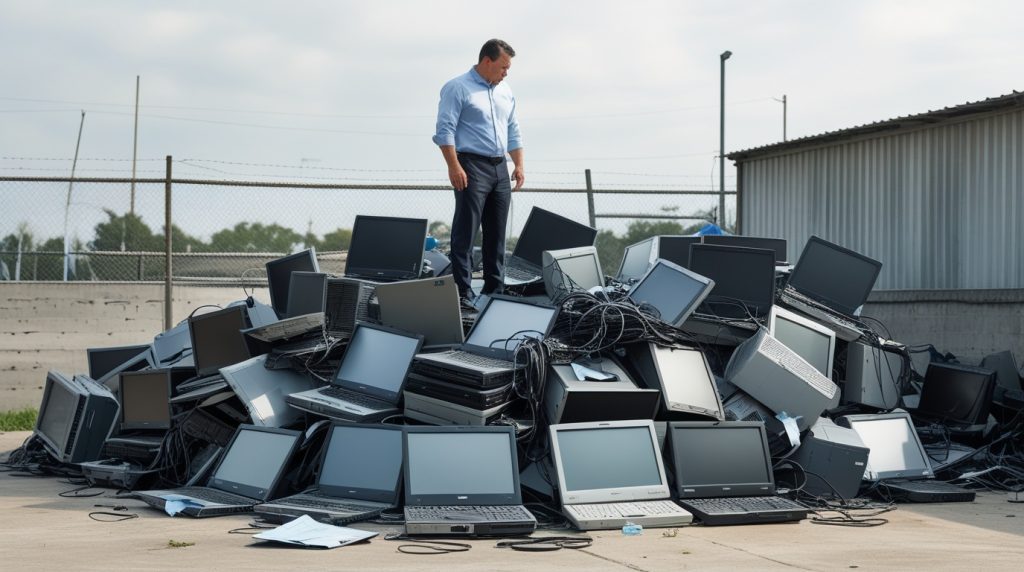
And here is what we see in almost every company that buys: the fully depreciated machine stays in use, because “it still works”. The books say it has finished costing, so replacing it feels wasteful. The result is a fleet that ages quietly, until the day it ages loudly.
That day had a precise date: 14 October 2025, the end of support for Windows 10. Anyone who kept PCs beyond that date and still wants security updates pays for them through a dedicated programme in which, according to Microsoft’s documentation, the cost per device doubles at each annual renewal and the programme runs for no more than three years. We wrote about it ahead of the November price step: that article is a chronicle of what happens to a fleet that was bought and kept. None of those costs appeared in the depreciation schedule, and none was taken into account when the decision to buy was made.
What you actually buy with a monthly fee
This is the reversal, and it matters more than the acronym. An operating lease is not “renting instead of owning”. It is buying continuous alignment instead of an object: the unit of measure changes, from asset to service.
In our case an operating lease typically runs for 36 months and includes configuration, delivery, installation and technical support on the devices for the whole term. It is not only about PCs: servers and storage, network equipment, printers, the devices of people who work off-site. The fee can also include software licences and operational support, to the extent defined in the contract. At the end you choose: buy the devices out by paying the residual value set in the contract, or renew with a new generation of machines. The monthly fee is fixed, so the IT budget is known in advance and there is no upfront outlay to reopen the same discussion every three years.
Put that way, three objections can be raised to “We’d rather buy it, so it goes down as CAPEX”, all of them technical.
First: capital gets locked into the asset that loses value fastest. Of everything a company buys, the computer is among the things that depreciate soonest. Tying up capital there, rather than in assets that hold their value, is a choice that deserves at least one question.
Second: the costs that arrive after depreciation appear nowhere. Paid updates, downtime, the time of people waiting on a slow computer, the emergency replacement when the last one dies. These are real costs that the buy-and-keep model never records, because as far as the books are concerned that machine has already finished costing. With a monthly fee the cost of staying current is visible every month, and can be discussed.
Third: cash. No upfront payment, a constant amount, no spending spike every three years. For many small companies this counts for more than the long-run arithmetic, because it is today’s liquidity that decides what can be done tomorrow.
When buying is still the right choice
We do not write that leasing is always better, because it is not true. Buying remains the right choice when the asset has a long life relative to the speed at which technology overtakes it, when there is an investment incentive to claim, when there are particular needs around ownership or customisation. For companies reporting under international accounting standards, the treatment of lease contracts changed from 2019, and that is a matter for whoever prepares the accounts: we do not simplify it here, because simplifying it badly would be worse than leaving it out.
What makes the difference is how fast the asset loses value, not the formula itself. And that is a question you can answer by looking at your own fleet, not at a price list.
Our view
When a client tells us they would rather buy, we do not answer with a tax table. We ask three things: how old the machines in use today are, how many are still in use after finishing their depreciation, and what happened the last time one of them stopped. The answers almost always say on their own whether the buy-and-keep model is working or merely postponing a bill.
From there the decisions are simple: what to lease because it ages fast, what to buy because it lasts, and what does not need changing at all. The accountant closes the loop on the tax side, we close it on the technical side. Get in touch and we will start from the fleet you have: a needs assessment, with no obligation, tells you where a monthly fee makes sense and where it does not.
Frequently asked questions
What do CAPEX and OPEX mean in business IT?
CAPEX is capital expenditure: an asset is purchased, recorded among fixed assets and depreciated over the years. OPEX is operating expenditure: a running cost booked in the year, like the fee for an operating lease. Italy’s national accounting standards place payments for the use of third-party assets and depreciation in two distinct lines of the income statement. The tax effect in a specific case must be checked with an accountant.
Is an operating lease always better than buying?
No, and it depends on the asset. A monthly fee suits technology that loses value fast, because it avoids the upfront outlay, makes the cost predictable and puts the replacement of machines inside the contract rather than inside an emergency. Buying remains the right choice when the asset has a long life, when there are investment incentives to claim, or when there are particular ownership needs. The economic and tax assessment of the specific case should be made with an accountant.
What is the difference between an operating lease and a finance lease in Italy?
The finance lease has had a statutory definition in Italian law since 2017; for the operating lease no statutory definition of its own appears to exist. The Nuova Sabatini incentive, in the law that created it, refers to purchase and finance leasing: the operating lease does not appear in that text, and if an incentive is at stake the position must be checked case by case. An operating lease is a service contract: you pay a fee to use configured, supported devices, and at the end you choose whether to buy them out or renew.
What happens to the computers at the end of the lease?
In our case, at the end of the term the devices can be bought out by paying the residual value set in the contract, or the fleet can be renewed with a new generation of technology. During the contract, configuration, installation and technical support are included.
Sources
- Our operating lease service: what can be leased, how it works, common questions
- OIC 12, structure and formats of the financial statements (Italian Accounting Standards Board, in Italian): income statement lines B8 and B10
- Decree-Law 69 of 2013, Article 2, consolidated text on Normattiva (in Italian): the law that created the Nuova Sabatini incentive
- Italian Ministry of Enterprises and Made in Italy, official page of the Nuova Sabatini capital goods incentive (in Italian)
- Microsoft Learn, the Extended Security Updates programme for Windows 10
- Law 124 of 4 August 2017, record in the Italian Official Gazette: the law that gave the finance lease a statutory definition
- Commission Regulation (EU) 2017/1986 on EUR-Lex, adopting IFRS 16 Leases, which applies to financial years starting from 1 January 2019
This article covers instruments and measures under Italian law: it applies to anyone running a business in Italy, including companies headquartered abroad. The information is drawn from the official sources listed above and is current as at the date of publication. It does not constitute tax, accounting or legal advice: an assessment of your specific case, including the treatment in the accounts, the tax effects and access to incentives, should involve the company’s accountant.