
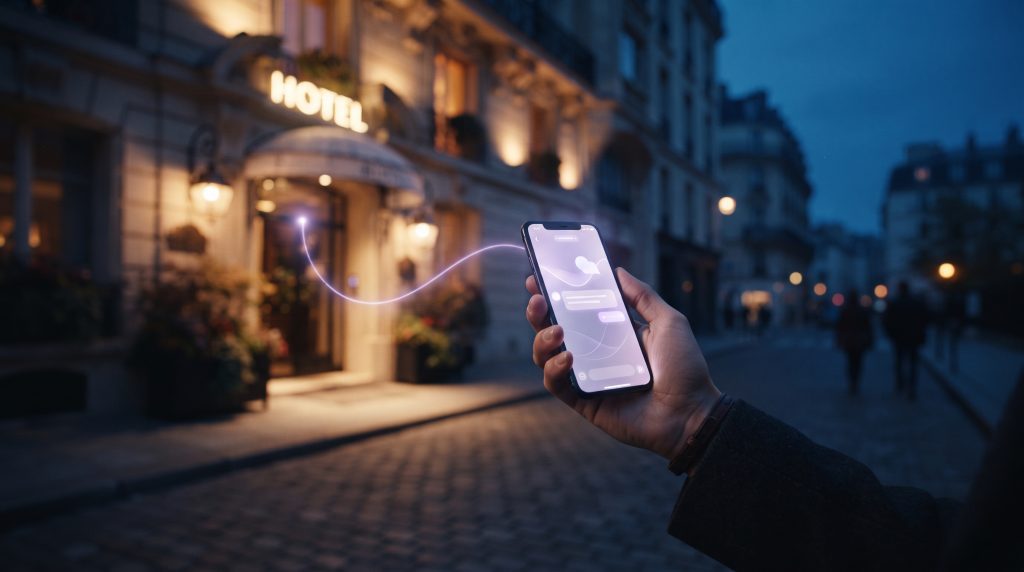
The scene is new but becoming normal: a traveller opens ChatGPT and types “where should I stay in Florence for a weekend?”. They don’t scroll through OTAs or compare ten listings. They ask the assistant, and it replies with a few properties: the ones it can understand and considers reliable.
This isn’t a conference scenario. On 4 June 2026 IHG (the group behind InterContinental, Holiday Inn and Kimpton, over 6,000 hotels across around a hundred countries) launched its own app inside ChatGPT: the user searches, compares and explores the group’s hotels right in the chat, with availability, pricing, maps and amenities, and is then guided to booking on IHG’s channels. And it didn’t stop there: on 28 July it extended the same AI conversational search to its own website and the IHG One Rewards app (in beta, US first). Marriott and Hilton are moving onto the same ground. As Jolie Fleming, IHG’s chief product & technology officer, put it, the goal is to make travel “more seamless, from planning through to the stay”, pairing AI with human hospitality.
AI is the new shop window, not (yet) the till
Be careful not to misread the numbers. Bookings actually completed inside a chatbot are still a niche: they remain below 1%. But that isn’t where the game is played: AI has become the place of discovery and recommendation. Already today, per Phocuswright (March 2026), 56% of US travellers use AI to plan, book or get assistance during a trip; nearly 90% say they’ll use it to plan, and traditional search volumes are projected to fall around 25% by 2026. People decide based on what the assistant recommends, then complete the booking wherever they prefer, and those arriving from an AI recommendation convert better than traditional search traffic.
There’s a signal a hotelier should watch closely: on searches “touched” by AI, the organic click-through rate has collapsed from 1.76% to 0.61% (Cvent data). People read the answer and no longer click ten links. And when AI recommends a property, it largely sends traffic to the hotel’s direct channel, not to the OTAs.
The condition: that AI can “read” your property
Assistants don’t read a site the way a guest would: they analyse data, structure and consistency of information to understand who you are, what you offer and who you’re for. The chains are building this with their own systems. The independent hotel, if its site and data aren’t understandable to the AI, simply doesn’t appear in the answer: in its place the assistant cites the OTAs or competitors. It’s what the industry calls GEO (Generative Engine Optimization): no longer “ranking on Google”, but being the source the AI cites when it generates its answer.
What a hotelier can do today
The good news is twofold. First: you don’t need to chase a fad, you need to put order into concrete things, many of which a property should already be looking after. Second: you don’t need to be a global chain. In a case cited by Cvent, one property went from zero mentions in AI assistants to being cited in 40% of relevant queries, simply by restructuring and better organising its own content.
- Structured data and “answer-ready” information: amenities, policies and availability described so a machine can interpret them without ambiguity.
- A well-kept, consistent Google Business Profile: one of the sources assistants read most; it must say the same things as your site.
- Consistency across sources: different data across site, OTAs, social and directories makes you look “confused” and the AI discards you. Those cited consistently across many sources win.
- A site readable by the assistants: their crawlers must be able to access the pages, and the content must be clear and well structured.
- Knowing how you’re described: most hotels don’t even know which queries they’re cited for, ignored on, or described badly by the AI. Measuring it is the first step.
Our point of view
This is exactly the ground we work on with our hospitality clients: site, Google Business Profile and consistent structured data are the base the assistants read. It is one part of the IT consulting for hotels we do every day, alongside connectivity, property systems and guest-facing tools. Making a property understandable to AI isn’t magic: it’s order, consistency and care for the data.
If you want to understand how your property is seen today by AI assistants and what it takes to be recommended, book a free consultation on the topic: we start from an analysis of your presence and tell you, concretely, where to act.